

Why Sellers Without Advisors Lose (Even the Buyers Know It)
I came across something recently that perfectly sums up why selling your business without an advisor is one of the most expensive mistakes you can make, and this time the proof comes straight from the buyers themselves.
The Alliance of Mergers & Acquisitions Advisors (AM&AA), one of the most respected organizations in the industry, held a webinar for business buyers. The topic? How to find and approach sellers directly; in other words, without an intermediary.
And during that webinar, they ran this poll:
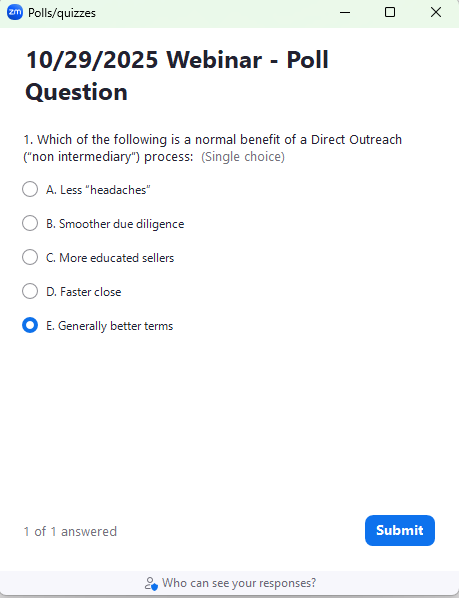
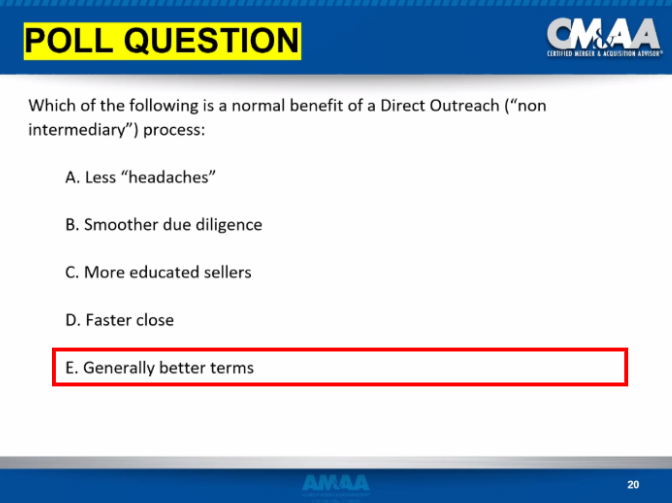
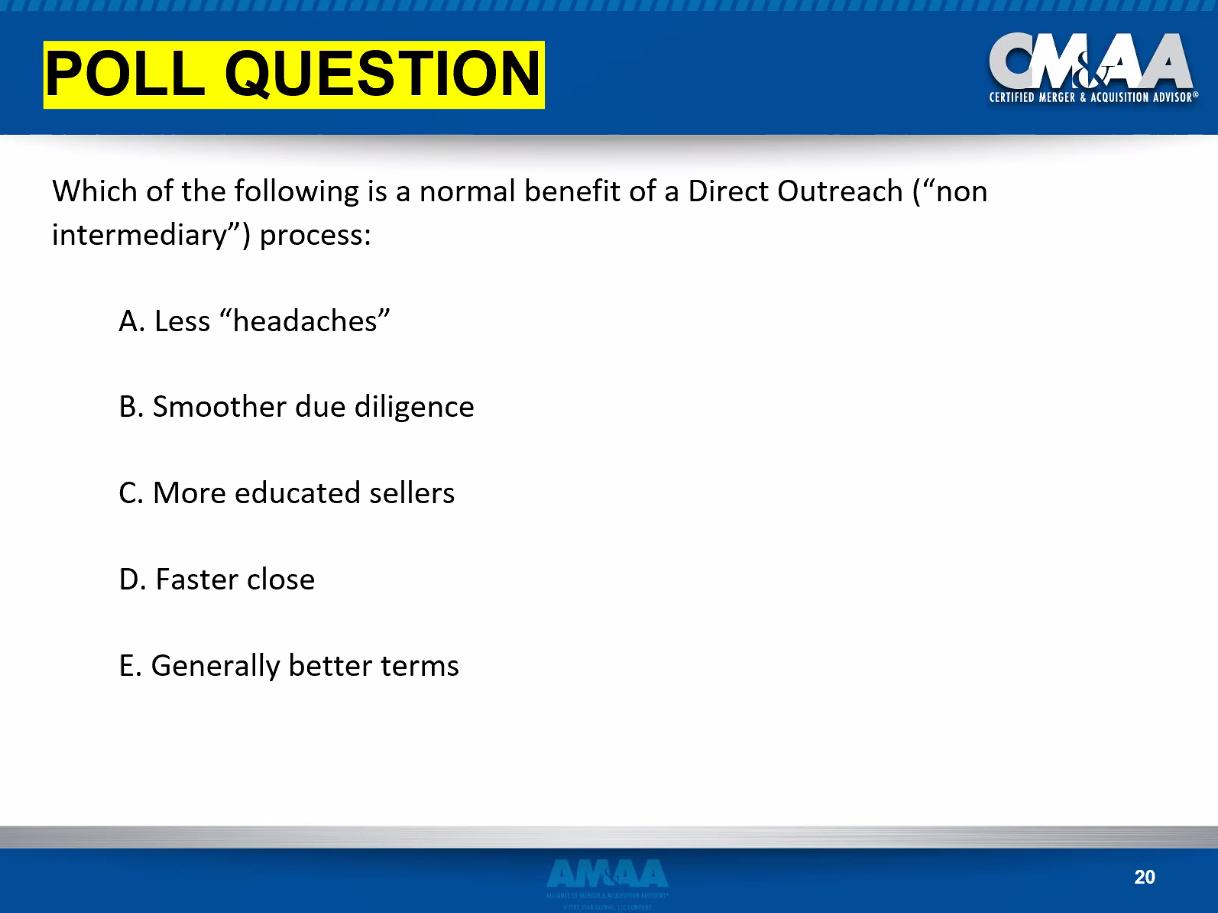
The question was simple:
“Which of the following is a normal benefit of a Direct Outreach (‘non-intermediary’) process?”
Here were the results:
- Less headaches – 11%
- Smoother due diligence – 16%
- More educated sellers – 5%
- Faster close – 5%
- Generally better terms – 63%
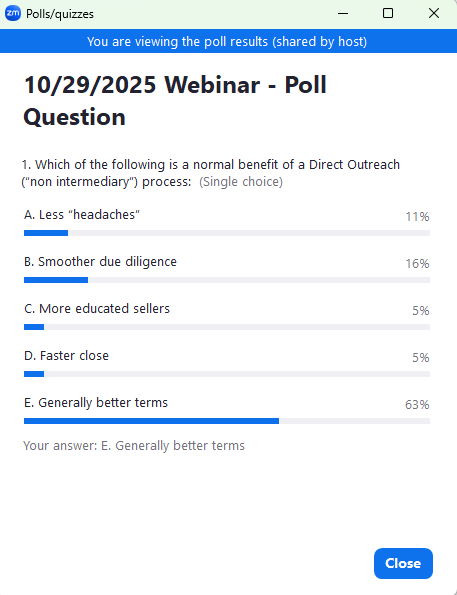
And here’s the kicker; the administrator confirmed that “Generally better terms” was the correct answer.
So not only do most buyers believe they’ll get better deal terms when they find a seller without an advisor… the people teaching the class confirm it.
Let that sink in.
What This Means (And Why It Should Worry Every Seller)
These results weren’t taken from a group of advisors or brokers. These were buyers and buy-side professionals; the people on the other side of the table.
And what they’re saying out loud in a professional M&A setting is that when they find a business without an advisor involved, they expect:
- More headaches
- Harder due diligence
- Less educated sellers
- A slower closing process
- And better deal terms... for them.
Read that last one again.
Buyers literally believe that when a seller doesn’t have representation, they get better terms.
That means a lower price.
Worse structure.
More risk pushed onto the seller.
And fewer protections built into the deal.
So while many business owners convince themselves they’re “saving money” by avoiding advisor fees, what’s really happening is they’re giving away multiples of that amount in deal value, and the buyers know it.
Even the Industry Recognizes the Imbalance
To be clear, organizations like the AM&AA do incredible work educating both buyers and advisors. They bring transparency to an industry that has historically been opaque, and they help raise the standard of professionalism on both sides of the table.
But this poll highlights an uncomfortable truth: when there isn’t an advisor involved, the playing field isn’t level.
Buyers tend to have more experience, more resources, and more deal repetitions under their belt. Without an advisor, sellers are often walking into that environment alone, trying to navigate complex due diligence, valuation models, and legal terms while still running their business day-to-day.
That’s not a criticism of the AM&AA. In fact, it’s exactly the kind of insight that shows why seller-side representation is so critical. It proves that even within respected educational settings, everyone including the buyers recognizes what happens when that balance of experience tips too far in one direction.
The Takeaway: If the Buyers Know, You Should Too
If the people buying companies are openly saying, “We get better terms when sellers don’t have advisors,” that should tell you everything you need to know.
Selling your business isn’t just about finding a buyer. It’s about protecting value.
It’s about knowing what you’re worth, how to structure the deal, and how to defend it through closing.
That’s what an experienced M&A advisor does — they level the playing field.
Because the next time a buyer shows up saying, “Let’s just work this out directly,” you should remember:
They already know that without representation, they win and you lose.